The 'Brain' You Own vs. The 'Brain' You Rent: Why Open Source Wins the AI Business War
Dev Narang
January 2026
The "Brain" You Own vs. The "Brain" You Rent: Why Open Source Wins the AI Business War
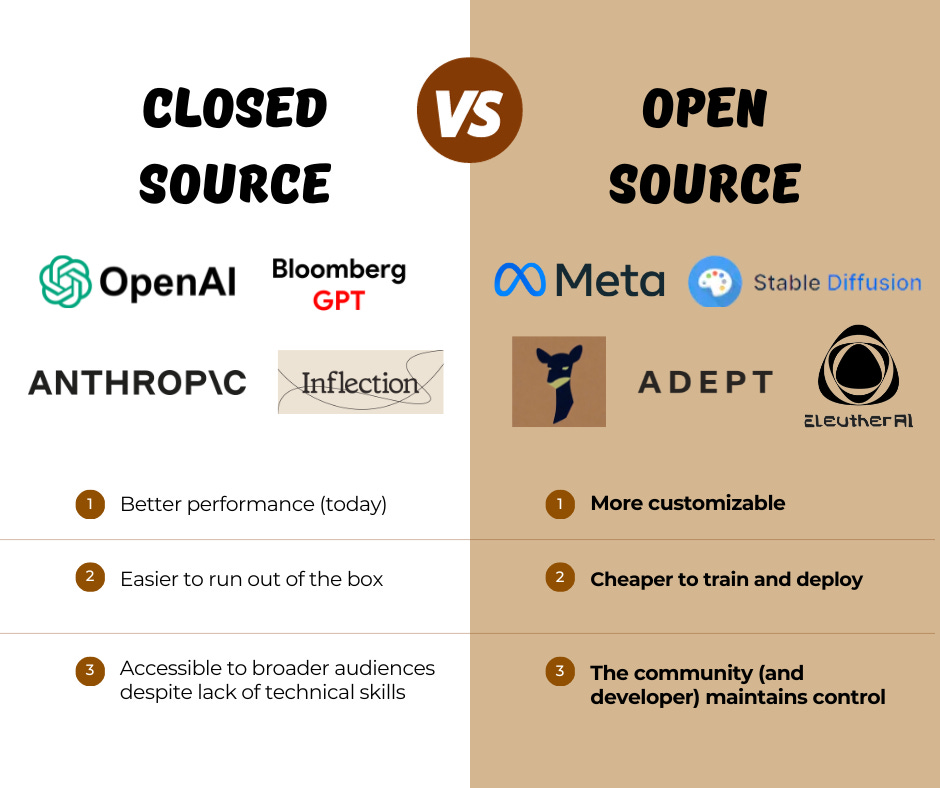
The artificial intelligence landscape is currently split between two opposing philosophies. On one side, OpenAI (Closed Source) offers a polished, proprietary product behind an API. On the other, Meta (Open Source) releases the raw "weights" of its models (like Llama), allowing anyone to download, modify, and run them.
While OpenAI's "intelligence-as-a-service" offers immediate convenience, Open Source is the superior long-term business model. For enterprises, the ability to control the underlying technology is not just a luxury—it is a strategic necessity.
1. Controlling the Reward Function (The RL Advantage)
The most critical—yet often overlooked—business advantage of open source is control over Reinforcement Learning (RL).
In closed models like GPT-4, the model's behavior is dictated by OpenAI's internal Reinforcement Learning from Human Feedback (RLHF). They decide what the model considers "helpful," "safe," or "biased." This creates a "black box" alignment where the model might refuse to answer legitimate business queries (e.g., generating aggressive financial trading strategies or analyzing sensitive medical data) because it conflicts with OpenAI's generic safety filters.
Open source models democratize this process. Because you have access to the model weights, you can apply your own Reinforcement Learning strategies. You can fine-tune the model's "reward function" to prioritize your specific business KPIs—such as code efficiency, legal precision, or brand voice—rather than accepting a generic, one-size-fits-all alignment. You aren't just prompting the model; you are fundamentally rewiring how it weighs decisions.
2. Strategic Sovereignty and Cost Control
Beyond the technical ability to rewire the model, open source offers strategic independence. Relying on a closed API introduces a massive "platform risk." If OpenAI changes their pricing, deprecates a model, or alters their terms of service, your entire product could break overnight.
Open source models grant you "sovereignty." You download the model and host it on your own servers.
Data Privacy
Your proprietary data never leaves your infrastructure, which is a requirement for highly regulated industries like defense and healthcare. According to IBM's 2025 research, 51% of businesses using open-source tools saw positive ROI, compared to just 41% of those that weren't—largely due to the transparency and control open source provides.
Cost Efficiency
At scale, running your own fine-tuned Llama model is often significantly cheaper than paying per-token API fees to a vendor. While there are upfront infrastructure costs, Built In notes that an open-source, self-hosted model may become operationally more cost-effective when monthly requests approach millions of interactions.
3. The Innovation Advantage
Open source accelerates innovation through collaboration. As highlighted by the Linux Foundation, with over 100,000 developers contributing to AI projects across 3,000+ organizations, the collective expertise far exceeds what any single company can achieve internally.
This collaborative ecosystem means:
- Faster bug fixes and security patches
- Community-driven improvements and optimizations
- Shared knowledge on best practices and implementation strategies
- Transparency in how models work and make decisions
4. Customization for Your Domain
Generic closed-source models are built for everyone, which means they're optimized for no one in particular. Open-source models can be fine-tuned specifically for your industry's terminology, regulatory requirements, and unique workflows.
Whether you're in healthcare, legal, finance, or manufacturing, you can train the model on your domain-specific data and workflows without worrying about that sensitive information being used to train your competitor's AI.
Conclusion
OpenAI sells a fish; Meta gives you the genetics to breed your own. While closed-source models currently offer a lower barrier to entry, open-source models provide the customization, privacy, and control required to build a defensible business moat. In the long run, businesses will always prefer the brain they own over the brain they rent.
As we move into 2025 and beyond, the trend is clear: models are getting smaller and smarter, multimodal capabilities are expanding, and ethical AI is opening new business opportunities. The question isn't whether to adopt open source—it's when.
References
-
IBM. (2025). Open-source AI in 2025: Smaller, smarter and more collaborative
-
Simplenight. (2025). Open Source vs Proprietary AI Models: Who's Winning the Race in 2025?
-
TechDogs. (2025). Open-Source AI Vs. Closed-Source AI: Which One Is Right For Your Business?
-
Built In. (2025). Why Should Your Startup Use Open-Source AI Models?
-
PromptLayer. (2025). Llama 3 vs GPT 4: A Detailed Comparison
Dev Narang
Web developer and tech enthusiast sharing knowledge and experiences.
Comments (0)
Related Posts

Why I Chose to Study Data Science
For me, what makes data science so exciting is that it really lets you create real things with tangible results out of a messy, complicated world.
Building a Voice-Controlled 3D Design Assistant with MCP
From voice commands to projected 3D designs - how we used Model Context Protocol to create an agentic AI system that turns spoken language into interactive 3D scenes.